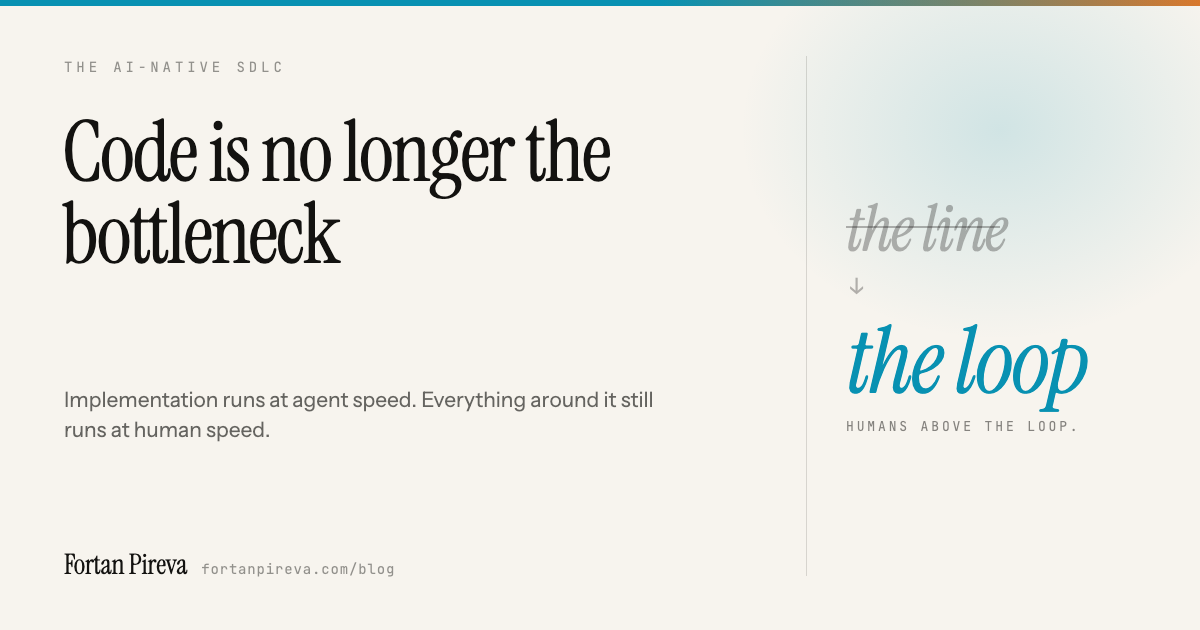
For decades, the core assumption underlying software engineering management was simple: writing and implementing code was the most expensive, time-consuming phase of software delivery. Traditional Software Development Lifecycles (SDLCs), from Product Requirement Documents (PRDs) and estimation rituals to multi-layered change advisory boards, were explicitly engineered to maximize control over human coding capacity.
As documented in The AI-Native SDLC Playbook by Anthropic, agentic AI tools have fundamentally dismantled this constraint. Engineering teams now generate production-grade code at speeds unimaginable even a year ago. However, despite implementation times collapsing from weeks to minutes, feature cycle times across enterprise software teams frequently remain unchanged.
The core friction is structural: while implementation now moves at agent speed, the surrounding governance, planning, testing, deployment, and operational phases still move at human speed. When high-volume machine-generated code hits traditional sequential checkpoints, governance controls stop matching reality, review queues overflow, and process overhead multiplies. Achieving true productivity gains requires transforming the linear SDLC into an automated, continuous loop driven by version-controlled artifacts and governed by humans “above the loop.”
1. The Bottleneck Has Moved: Why Traditional SDLCs Break Down
The traditional SDLC operates as a linear sequence of discrete handoffs (“The Line”). A product manager drafts requirements, a technical architect creates designs, engineers write code, QA teams verify behavior, release management handles deployments, and operations monitors runtime health. Work transitions between these siloed roles through tickets, documentation, and manual sign-offs.
Traditional SDLC ("The Line"):
[ Plan ] -> [ Design ] -> [ Build ] -> [ Test ] -> [ Deploy ] -> [ Maintain ]
(All stages run at human speed; long feedback cycles between releases)
When agentic solutions accelerate the Build stage to near-zero latency, three critical friction points emerge across the engineering organization:
- Shift of Constraints to Surrounding Stages: The primary bottlenecks relocate immediately to the left (Planning and Design) and to the right (Testing, Deployment, and Maintenance). Because planning sessions and manual PR reviews still operate on human schedules, overall cycle time remains bound by human latency.
- Intractable Manual Reviews: Line-by-line manual code review was designed under the assumption that a human authored every line of the diff. When AI agents generate hundreds of lines of verified code in seconds, manual line-by-line inspection becomes an impossible queue, leading either to severe release backlogs or under-reviewed code reaching production.
- Escalating Governance Costs: Enterprise governance that relies on weekly change boards or monthly steering committees creates severe artificial delays when development iterations occur multiple times per day.
2. From “The Line” to “The Loop”: The AI-Native Operating Model
To eliminate handoff friction while maintaining organizational control, The AI-Native SDLC Playbook introduces The Loop. Rather than passing tickets along a linear pipeline, development becomes a continuous cycle where each stage automatically triggers the next by committing a machine-readable, version-controlled artifact.
AI-Native SDLC ("The Loop"):
         [ Plan (intent.md) ]
                 |
        [ Design (spec.md) ]
                 |
     [ Build (plan.md / CLAUDE.md) ]
                 |
      [ Test (Evals & Loops) ]
                 |
    [ Deploy (AI PR & Hooks) ]
                 |
      [ Maintain (Closed-Loop) ]
                 |
      (Feeds back into Plan)
In this model, human engineers transition from manual line-item coders to systems orchestrators. Humans operate above the loop, instigating intent, setting architectural direction, evaluating risk, and reviewing automated gates, while AI agents handle execution and verification within the loop.
Comparative Framework: Traditional vs. AI-Native SDLC
| SDLC Stage | Traditional SDLC (“The Line”) | AI-Native SDLC (“The Loop”) |
|---|---|---|
| Plan | Requirements gathered by committee, distilled through workshops, and manually drafted into PRDs over weeks. | Originator brainstorms with AI to capture raw problem space directly into a version-controlled intent.md. |
| Design | Specs written by analysts and parsed separately by designers in isolated, lossy handoffs. | Requirements and design collapse into a single prompted session, constrained by encoded organizational skills (spec.md). |
| Build | Code and tests written manually; documentation created reactively after implementation. | Work starts in plan mode (plan.md); code/tests are agent-generated using repository rules (CLAUDE.md). |
| Test | Manual QA gates and test execution enforced late at rigid stage boundaries. | Continuous local feedback loops run during generation; agent configurations undergo regression testing via CI evals. |
| Deploy | Humans manually inspect every line of code; release approval relies on committee sign-offs. | Multi-pass AI PR reviews filter diffs (REVIEW.md); deterministic execution hooks act as automated release gates. |
| Maintain | Operations teams reactively monitor production incidents and manually log backlog items. | Monitoring agents track statistical control bands (bands.yaml), automatically diagnosing anomalies into new intent.md files. |
3. The Currency of the Loop: Committed Machine-Readable Artifacts
The engine driving the AI-Native SDLC is the committed artifact. Each stage in the loop concludes by writing a version-controlled file into the repository, which immediately serves as the input trigger for the subsequent stage.
For the initial phases, structured Markdown files (.md) represent the primary currency because both human product owners and AI agents can seamlessly read, evaluate, and edit them. From the Build phase onward, artifacts transition into code diffs, execution traces, and audit logs.
The Audit Trail Rule: Every stage commits an artifact the next stage can read. Together,
intent.md,spec.md,plan.md, the code diff, test output, andREVIEW.mdconstitute an immutable, tamper-evident audit trail capturing who requested the change, what decisions were made, what code was generated, and who authorized release.
Source of Truth Integration Models
Enterprise environments often possess legacy tracking infrastructure, such as Jira, ServiceNow, or Figma, that cannot be abruptly replaced due to regulatory compliance. As detailed in the playbook, organizations can bridge legacy tools with the AI-Native SDLC using three integration patterns:
- Repository as Source of Truth: Markdown files in Git serve as the authoritative record. Legacy tools store links or references pointing to specific Git commit SHAs.
- Legacy System as Source of Truth: Enterprise tools maintain the master record. Agents read requirements via Model Context Protocol (MCP) connectors at session startup and write generated plans or status updates back into the legacy system.
- Dual Linkage Model: Git commits explicitly record legacy issue IDs, while legacy records store Git commit SHAs, maintaining bi-directional traceability across system boundaries.
4. Deep Dive: The Six Reimagined SDLC Stages
Stage 1: Plan: Capturing intent.md
In traditional workflows, product ideas linger in backlogs, undergoing refinement meetings and user story point estimations before an engineer writes a single line of code. By the time work reaches engineering, implementation details are often disconnected from the originator’s primary goal.
In the AI-Native SDLC, planning begins when an originator (a product manager, domain expert, or operations lead) brainstorms directly with an agent to capture intent in their own words. The agent asks analytical questions regarding scope, edge cases, target users, and constraints, generating a standardized intent.md file.
Standardized intent.md Artifact Structure
# Intent: Claims Status Self-Service
Author: J. Ortiz (Claims Operations)
Status: Draft

## Problem
Customers phone the contact center to ask where their claim is.
Handlers spend roughly a third of call time on status-only queries.

## Proposed Outcome
Customers see claim status, next step, and expected date in the portal.

## Affected Users and Systems
Claims handlers, portal team, claims-core API.

## Constraints
No new PII in the portal session. Existing authentication only.

## Open Questions
Do third-party loss adjusters need access too?
Once committed to a dedicated intent/ folder within the repository, the product owner reviews and accepts the artifact. Merging the intent.md pull request officially fires the trigger for Stage 2.
- Leading Indicator: Time from initial conversation to a committed
intent.md(collapsing from weeks to hours). - Lagging Indicator: Survival rate of
intent.mdfiles accepted into Design versus rejected, and volume of post-design modifications to intent.
Stage 2: Design: Collapsing Requirements and Specs
Traditional software design separates requirements writing from architectural and visual design. In the AI-Native SDLC, requirements and design collapse into a single prompted working session.
The agent ingests intent.md alongside organizational skills, version-controlled policies defining brand guidelines, security rules, UX patterns, and compliance mandates. The agent synthesizes these constraints to generate a complete spec.md file while explicitly flagging policy contradictions or technical risks.
[ intent.md ] + [ Org Skills (Security, UX, Brand) ]
                     | (Prompted Agent Session)
                     v
             [ spec.md ] (with Flagged Policy Risks)
The product owner reviews the generated spec.md, resolves flagged concerns directly with policy owners, and commits the file pair (intent.md and spec.md). Human approval of spec.md automatically triggers Stage 3.
- Leading Indicator: Elapsed time between
intent.mdcommit andspec.mdcommit for the same change. - Lagging Indicator: Requirements rework after development starts, measured by
spec.mdcommits dated after the initialplan.mdcommit.
Stage 3: Build: Plan Mode, System Context, and Parallel Execution
The Build phase shifts software creation from manual typing to plan-first agentic execution. Engineers execute work using four primary pillars:
1. Plan Mode as a Mandatory Gate
Engineers launch sessions in Plan Mode, where the agent analyzes the repository without altering any files. The agent reads intent.md and spec.md and produces a structured plan.md naming exact file changes, execution sequence, risks, and verification steps.
# Plan: Claims Status Self-Service (from intent.md 2026-06-02)

## Files That Change
portal/src/claims/StatusPanel.tsx (new)
claims-api/routes/status.py
claims-api/tests/test_status.py

## Order of Work
1. Add the status endpoint behind existing auth.
2. Build StatusPanel component against the endpoint.
3. Wire component into portal navigation.

## Risks
The claims-core API rate-limits at 50 rps; the panel must cache responses.

## Proof
test_status.py covers the four claim states; visual screenshot matches approved mock.
The engineer interrogates and approves plan.md before permitting the agent to edit code. Once committed, implementation often finishes in a single autonomous pass.
2. System Context via CLAUDE.md
To prevent agents from making repetitive architectural or environment errors, teams maintain a root-level CLAUDE.md file. This concise file captures essential commands, code conventions, directory layouts, and historical pitfalls.
# Payments Service Context

## Commands
- Build: make build
- Test: make test (unit), make itest (integration, requires Docker)
- Lint: make lint (runs in CI; fix before pushing)

## Conventions
- Java 21, Spring Boot 3. No Lombok.
- Currency amounts must use BigDecimal, never double.
- Every endpoint requires an integration test in src/itest.

## Architecture
- api/ holds REST controllers; core/ holds domain logic; adapters/ talks to external systems.
- Kafka events are defined in schemas/; never edit generated classes directly.

## Anti-Patterns & Common Agent Errors
- Do not bump dependency versions; platform team owns dependencies.
- The legacy v1/ package is frozen; all new routes go in v2/.
The Two-Mistake Rule: Whenever an AI agent repeats a contextual or architectural mistake twice, the team updates
CLAUDE.mdwith the corrective rule.
3. Operationalizing Policy with SKILL.md
Organizational rules that require broad, consistent application across repositories are packaged into reusable skills (.claude/skills/<name>/SKILL.md).
---
name: secure-api-review
description: Apply API security standards whenever creating/modifying external endpoints or OpenAPI specs.
---
# Secure API Review Standards
When creating or altering an API endpoint:
1. Authentication: Enforce gateway JWT validation; no anonymous routes except /health.
2. Input Validation: Validate request bodies against OpenAPI schemas; reject unknown fields.
3. Audit Logging: Emit state-changing audit events containing actor, action, entity, and timestamp.
4. Data Classification: Fields tagged PII must never appear in logs or error messages.
Run scripts/check-endpoints.sh and append output to summary.
4. Parallel Sessions and Specialized Subagents
Rather than managing a single linear task, engineers run multiple agent sessions simultaneously across separate Git worktrees (claude --worktree feature-auth). Worktrees prevent file collision while allowing an engineer to orchestrate 3 to 4 parallel streams of development.
To keep main context windows clean, specialized subagents (.claude/agents/verifier.md) handle recurring tasks, such as running local build targets or taking screenshot diffs.
Stage 4: Test: Autonomous Feedback Loops and CI Evals
Testing in the AI-Native SDLC operates across two complementary tiers: developer feedback loops during code generation, and continuous evals for agent configuration.
1. Local Verification Loops
Before presenting code for human review, the agent must verify its own work through automated feedback loops configured in CLAUDE.md. The agent runs local builds, unit tests, linters, or visual browser checks, iterating autonomously until all verification checks pass.
## Verifying Your Work
- Build: make build (must output "Build Succeeded")
- Test: make test (all green; never skip or delete failing tests)
- Lint: make lint (zero warnings)
Run all three checks before reporting a task complete. If a test fails, fix the implementation code, not the test.
To prevent an agent from improperly modifying test assertions to pass a check, teams implement deterministic build-phase hooks that lock test files during bug-fix tasks.
2. Continuous Evals in CI
Because agent behavior is driven by markdown context (CLAUDE.md, skills, hooks, and model prompts), changes to configuration require regression testing just like application code. Continuous evals in CI run a suite of 20 to 50 canonical engineering tasks against headless agent instances on a scheduled cron or pull request trigger.
name: Agent Configuration Evals
on:
  pull_request:
    paths: ['CLAUDE.md', '.claude/**']
  schedule:
    - cron: '0 2 * * *'
jobs:
  evals:
    runs-on: ubuntu-latest
    steps:
      - uses: actions/checkout@v4
      - run: npm install -g @anthropic-ai/claude-code
      - name: Execute Eval Suite
        env:
          ANTHROPIC_API_KEY: ${{ secrets.ANTHROPIC_API_KEY }}
        run: |
          for eval in evals/*.json; do
            claude -p "$(jq -r '.prompt' $eval)" \
              --allowedTools "Read,Edit,Bash(make test)" \
              --output-format json > result.json
            ./evals/check.sh "$eval" result.json
          done
Stage 5: Deploy: AI PR Reviews and Approval Gates
In traditional workflows, pull requests create massive operational latency while waiting for human code inspection. In the AI-Native SDLC, deployment pipelines utilize multi-pass AI review automation paired with strict deterministic release gates.
1. Bi-Directional AI PR Review
Every pull request undergoes automated, multi-pass AI evaluation guided by a repository REVIEW.md policy file.
# Repository Review Instructions

## Passes
Execute three distinct passes and tag findings accordingly:
- Bugs: Logic errors, broken edge cases, subtle regressions.
- Security: Injection risks, authentication gaps, PII leakage in logs.
- Compliance: Verify changes conform strictly to spec.md and plan.md.

## Severity Thresholds
Reserve 'Important' tags exclusively for severe logic errors, data leaks, or security breaches. Style and naming items are classified as Nits.

## Limits
Cap reported Nits at 5 per review; summarize excess Nits as a total count.
Do not review generated files under src/gen/ or rules already enforced by CI.
When human reviewers or authors tag @claude in pull request threads, the agent automatically addresses feedback, pushes code updates, and re-runs verification checks.
2. Hooks as Deterministic Approval Gates
While skills are advisory, hooks provide non-bypassable, deterministic enforcement. Execution hooks intercept agent actions (such as terminal commands or file modifications) and can permit, block, or pause execution pending human sign-off.
{
  "hooks": {
    "PreToolUse": [
      {
        "matcher": "Bash",
        "hooks": [
          {
            "type": "command",
            "command": "${CLAUDE_PROJECT_DIR}/.claude/hooks/production-gate.sh"
          }
        ]
      }
    ]
  }
}
The underlying script (production-gate.sh) enforces release authorization policies deterministically:
#!/bin/bash
# Production deployment release authorization hook
cmd=$(jq -r '.tool_input.command' < /dev/stdin)

if [[ "$cmd" == *"deploy"* && "$cmd" == *"production"* ]]; then
  if [ -z "$RELEASE_APPROVAL" ]; then
    echo "ERROR: Production deployments require explicit release manager authorization." >&2
    exit 2 # Exit code 2 blocks the action and surfaces error message to agent
  fi
fi

exit 0
Stage 6: Maintain: Autonomous Closed-Loop Engineering
The final stage of the AI-Native SDLC shifts maintenance from a reactive, fire-fighting posture into an autonomous, closed-loop system.
1. Statistical Control Bands and Automated Intent Generation
Deterministic monitoring scripts continuously track operational telemetry (such as error rates, latency, or test failure percentages). Metrics are evaluated against rolling statistical control bands using rules like Western Electric.
metric: ci_test_failure_rate
baseline: rolling_30d
rules: western_electric
tiers:
  1sigma:
    action: log
  2sigma:
    action: diagnose
    tools: "Read,Grep,Bash(gh run view *)"
  3sigma:
    action: propose
    routes: [pull_request, "runbook:rollback-deploy"]
When production telemetry breaches a 3 sigma threshold:
- The monitoring hook automatically triggers a headless agent session.
- The agent analyzes logs, identifies root causes, and drafts a new
intent.mddetailing the incident, affected systems, and proposed fixes. - The generated
intent.mdenters Stage 1 of the loop, opening a pull request for human triage and approval.
2. Real-Time Incident Response via Channel Agents
Incidents arriving via collaboration tools (such as Slack or Microsoft Teams) are handled in real-time by first-responder agents (such as Claude Tag).
The agent operates directly within the incident channel, analyzing deployment diffs, executing approved rollback runbooks upon human confirmation, and automatically writing post-mortem summaries into repository lessons files (lessons/incident-postmortem.md).
[ Incident Alert in #inc-checkout ]
  |-> Human: "@claude 5xx rate spiking post-deploy."
  |-> Agent: Diagnoses cache key missing tenant ID; suggests rollback.
  |-> Human: "Go."
  |-> Agent: Triggers rollback, verifies metric recovery, commits post-mortem.
5. Enterprise Security & Administration Architecture
For regulated enterprise environments, organizational policy must be centrally governed so that local developer configurations cannot override security bounds. The AI-Native SDLC Playbook defines a managed admin settings structure deployed via Mobile Device Management (MDM) or administrative consoles:
{
  "permissions": {
    "deny": [
      "Read(.env*)",
      "Read(./secrets/**)",
      "WebFetch",
      "Bash(curl *)",
      "Bash(wget *)"
    ],
    "allow": [
      "Bash(git *)",
      "Bash(make build)",
      "Bash(make test)",
      "Bash(make lint)"
    ],
    "disableBypassPermissionsMode": "disable"
  },
  "allowManagedPermissionRulesOnly": true,
  "sandbox": {
    "enabled": true,
    "failIfUnavailable": true,
    "allowUnsandboxedCommands": false,
    "network": {
      "allowedDomains": [
        "git.internal.example.com",
        "registry.npmjs.org"
      ]
    },
    "credentials": {
      "files": [
        { "path": "~/.ssh", "mode": "deny" },
        { "path": "~/.aws/credentials", "mode": "deny" }
      ],
      "envVars": [
        { "name": "GITHUB_TOKEN", "mode": "deny" }
      ]
    }
  },
  "allowManagedHooksOnly": true,
  "disableSideloadFlags": true,
  "allowManagedMcpServersOnly": true,
  "strictKnownMarketplaces": [
    { "source": "github", "repo": "example-corp/approved-plugins" }
  ],
  "requiredMinimumVersion": "2.1.193"
}
Security Control Mapping
permissions.deny& OS Sandboxing: Restricts file reading of sensitive environment secrets (.env, SSH keys, AWS credentials) while blocking arbitrary outbound network requests at the kernel level via network domain allowlists.disableBypassPermissionsMode&allowManagedHooksOnly: Prevents individual developers or repository flags from disabling mandatory organizational approval hooks or security rules.strictKnownMarketplaces&allowManagedMcpServersOnly: Ensures all skills, subagents, and Model Context Protocol (MCP) integrations are installed exclusively from vetted corporate plugin registries.
6. Implementation Strategy: How Engineering Teams Can Start Today
Transforming an enterprise engineering organization from “The Line” to “The Loop” does not require a disruptive, all-at-once overhaul. The plays defined in the playbook are modular, allowing teams to prioritize stage transformations based on immediate operational pain points.
Dependency Graph for SDLC Transformation:

[ CLAUDE.md ] --------> [ Local Feedback Loops ] ----> [ Continuous Evals ]
      |                         |
      v                         v
[ Plan Mode ] --------> [ Parallel Worktrees ] ------> [ AI PR Reviews ]
      |                                                     |
      +-----------------------------------------------------+-----> [ Closed-Loop Maintenance ]
Recommended Rollout Sequence
- Step 1: Context Foundation (
CLAUDE.md)- Run
/initin your primary repository to create a baselineCLAUDE.md. - Trim the file to single-page length, capturing build/test commands, formatting conventions, and common pitfalls.
- Run
- Step 2: Adopt Plan Mode (
plan.md)- Mandate that engineers use Plan Mode before generating code diffs for complex tasks.
- Require
plan.mdcommits as a prerequisite for PR creation.
- Step 3: Establish Local Feedback Loops
- Configure verification targets in
CLAUDE.md(make test,make lint) so agents verify code locally before human inspection.
- Configure verification targets in
- Step 4: Automate Intent and Design Capture (
intent.md&spec.md)- Introduce standardized markdown templates for product originators to brainstorm intent directly with AI, bypassing multi-week backlog refinement cycles.
- Step 5: Integrate AI PR Reviews and Approval Hooks
- Deploy automated PR review policies (
REVIEW.md) and implement deterministic pre-tool execution hooks to safeguard production deployments.
- Deploy automated PR review policies (
- Step 6: Close the Loop with Autonomous Telemetry Monitoring
- Connect statistical control bands (
bands.yaml) to production metrics, allowing agents to diagnose anomalies autonomously and feed newintent.mdfiles back into Stage 1.
- Connect statistical control bands (
By moving from manual code execution to artifact-driven orchestration, engineering organizations can unlock the full velocity of agentic AI while elevating governance, code quality, and architectural integrity.